
130/705 H vs Industrial Sewing Machine Needle Systems
A 90/14 household needle and a 90/14 industrial needle can be the same thickness and still belong in completely different machines.
The number 90/14 is the size. It doesn't tell you the needle system.
For most conventional household sewing machines, the familiar system is 130/705 H. Industrial and specialist machines use many other systems, including 135x17, 135x16 and 134. Those systems can differ in shank shape, dimensions and other geometry that determines how the needle sits in the machine.
So an industrial needle isn't a tougher upgrade for a normal household machine.
It's a different compatibility question.
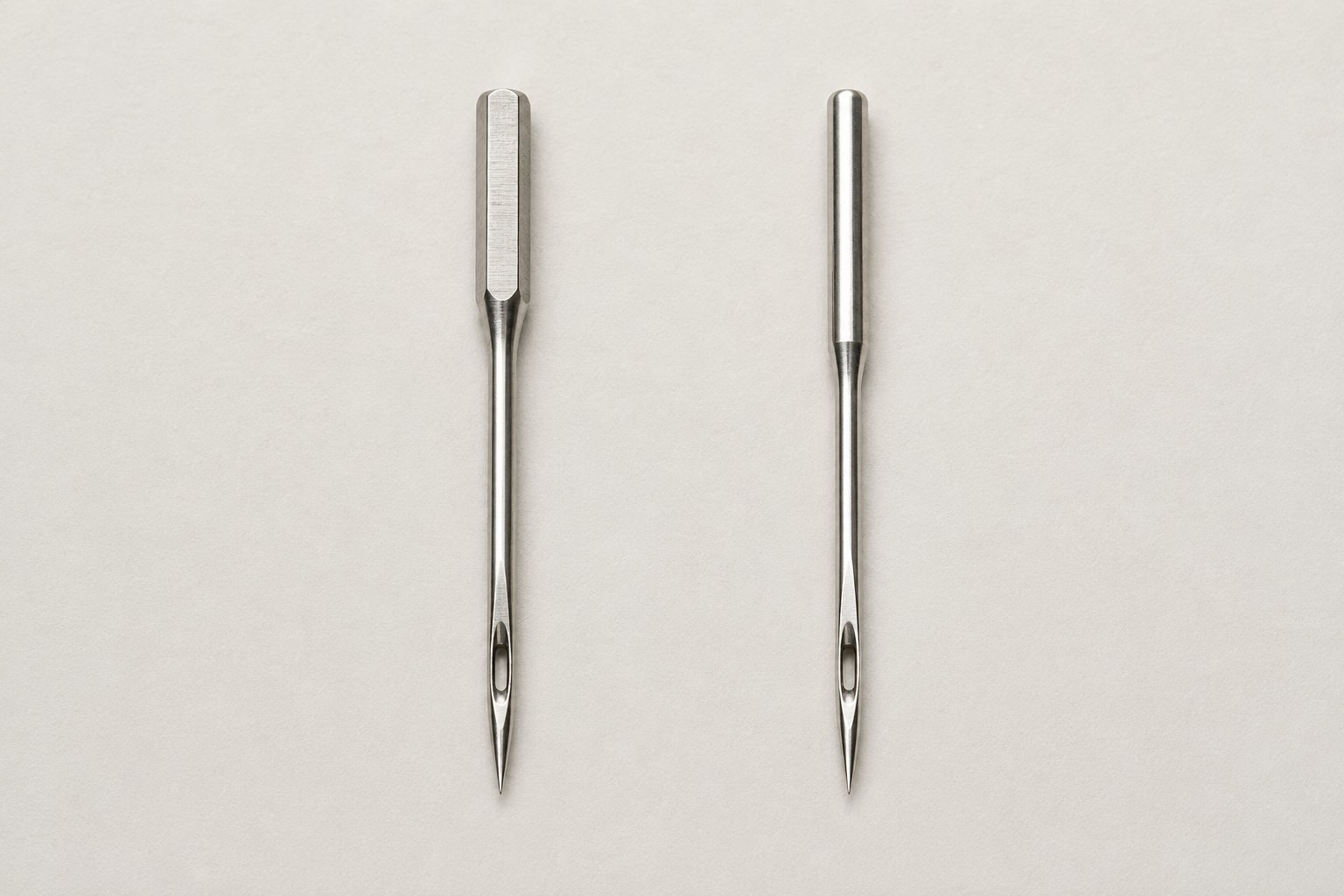
The short version
| Feature | 130/705 H | Industrial needle systems |
|---|---|---|
| Typical machines | Conventional household sewing machines | Industrial and specialist machines |
| Example systems | 130/705 H, with recognised alternate names | 135x17, 135x16, 134, DBx1 and many others |
| Shank | Flat on standard 130/705 H needles | Varies by system, often round |
| Needle sizes | Many sizes available | Many sizes available |
| Does matching size prove compatibility? | No | No |
| How to choose | Check exact machine specification | Check exact machine specification |
SCHMETZ describes 130/705 H as the system used by nearly all conventional household sewing machines. Its standard household needles have a flat shank. SCHMETZ also warns that needles from its Industrial Line can have different dimensions, shank geometry and scarf shapes and are not automatically compatible with standard household machines.
The table is a useful starting point.
The machine manual is still the answer.
130/705 H is a needle system, not a size
This is the first distinction to get right.
A packet might say:
130/705 H 90/14
Those numbers describe two different things.
130/705 H identifies the needle system.
90/14 identifies the needle size.
Change from a 70/10 needle to a 100/16 needle within the 130/705 H family and the needle becomes thicker, but it still belongs to the same basic household system.
SCHMETZ offers its 130/705 H Universal Needle in sizes from NM 60 through NM 130. The system remains 130/705 H across that range.
This is why shopping by size alone can go wrong.
A needle marked NM 90 is not automatically interchangeable with every other NM 90 needle.
What makes 130/705 H a household system?
The standard 130/705 H household needle has a flat section on its shank.
That flat side helps orient the needle when it is inserted into a conventional household sewing machine.
SCHMETZ lists several alternate designations around the same household system, including HAx1, 15x1 and 15x1 H. So a different code on the package does not always mean a different physical system. Verified cross-references are common in needle terminology.
Within the 130/705 H family, there are also many application-specific needles.
A Universal Needle, Jersey Needle, Stretch Needle, Jeans Needle and Embroidery Needle can all belong to the broader household-system family while having different points, scarves, eyes or other features for different materials.
The machine-compatible geometry comes first.
The sewing job narrows the choice after that.
Industrial needle is not one size or one system
There is no single industrial sewing machine needle.
Groz-Beckert's industrial catalogue alone contains systems such as DBx1, 134, 134-35, 135x17, UY128 and DBxK5, among many others.
That variety exists because industrial sewing machines are not one kind of machine either.
A single-needle lockstitch machine, compound-feed upholstery machine, cylinder-bed machine, overlock machine and embroidery machine can have completely different needle requirements.
So a listing that simply says “industrial sewing machine needles” is missing the information that matters most.
Which system?
135x17 is a useful real-world example
The JUKI DNU-1541 series is a compound-feed industrial machine designed for heavier work.
JUKI specifies 135x17 needles for the DNU-1541 series, with its current specification listing a standard NM 160 needle and an applicable range from NM 125 to NM 180.
That gives us two separate facts.
The machine needs the 135x17 system.
Within that system, different needle sizes can be used.
Changing the size does not change the system.
SewFitGuide keeps Needle System 135x17 as its own compatibility entity for exactly this reason.
A 135x17 in size 90 is still not a household 90/14
This is where the numbers become deceptive.
Imagine two needle packets. Both contain a needle corresponding to NM 90.
One is 130/705 H.
The other belongs to an industrial system.
The shared NM number describes blade thickness. It does not establish that the shank, length, eye position and other system geometry match.
SCHMETZ's own comparison makes the problem unusually clear. Its standard 130/705 H Universal Needle has a flat 2.04 mm shank. Its 134 industrial-family needles use a round 2 mm shank. Both families are available in overlapping needle sizes.
Same size number.
Different system.
Putting one into a machine designed for the other is not a clever cross-reference.
Round shank is a clue, not a universal industrial rule
Many industrial systems use round-shank needles.
That makes shank shape one of the quickest visual clues when comparing a standard 130/705 H household needle with certain industrial needles.
But don't promote that clue into a universal law.
SCHMETZ explicitly says industrial-line needles can have different dimensions and geometries, including different shank flattening or round shanks. In other words, the industrial category itself contains variation.
The visible shank can tell you that two needles are different.
It cannot reliably identify every industrial needle system sitting in a drawer.
For that, you still need the code.
System 134 shows why “household vs industrial” has exceptions
There is a useful complication here.
SCHMETZ describes 134 (R) as a standard needle system for industrial high-speed machines. It also says the 134 family can be used by certain high-speed household machines when the machine manufacturer specifies it.
Its 134 Universal Needle has a round 2 mm shank and is explicitly not compatible with ordinary household machines that require a flat-shank needle.
So this rule works:
Most conventional household machines use 130/705 H.
This rule does not:
Every machine sold for home use takes 130/705 H.
Specialist high-speed and longarm machines are exactly where broad rules start developing footnotes.
Check the exact machine.
134 can also appear under other names
Needle-system naming gets particularly entertaining once industrial cross-references enter the room.
SCHMETZ lists 134 (R), DPx5, 135x5, SY 1955, 135x7 and 797 together as compatible designations for machines using the relevant 134 family.
Those cross-references can be extremely useful when an older manual gives one designation and a modern needle package uses another.
But equivalence has to be established.
Do not assume two numbers describe the same needle because an online marketplace title contains both of them.
Manufacturers and specialist needle catalogues are much better places to resolve aliases.
135x16 and 135x17 show another industrial wrinkle
Some industrial and semi-industrial machines explicitly support more than one related needle system.
Sailrite's current Ultrafeed documentation, for example, specifies 135x17 or 135x16 needles in sizes #10 through #22. Its product specification also lists both systems as compatible.
Techsew likewise specifies both 135x17 and 135x16 for its 2750 PRO.
That does not mean every machine using 135x17 automatically accepts every 135x16 needle.
It means those particular manufacturers explicitly document both systems for those machines.
That difference is important.
A verified two-system specification is evidence.
A similar-looking number is not.
SewFitGuide therefore maintains separate pages for Needle System 135x17 and Needle System 135x16.
Can you use an industrial needle in a household sewing machine?
Not unless the machine manufacturer specifies that needle system.
For a conventional household machine designed around 130/705 H, a random industrial needle should not be treated as a substitute.
SCHMETZ explicitly warns that its industrial-line needles have different geometry and are not compatible with standard household sewing machines simply because a comparable needle size exists.
There are specialist machines that blur the category boundary, such as high-speed household machines using the 134 family.
That is an exception supported by the machine specification, not permission to experiment with whichever industrial needle fits into the clamp.
Can you use a household 130/705 H needle in an industrial machine?
The same rule works in reverse.
Only if the industrial machine manufacturer specifies 130/705 H.
An industrial machine does not become compatible with a household needle because both needles are available in size 100/16.
The machine's needle bar, hook or looper system is designed around particular needle geometry.
If the specification says 135x17, use 135x17.
If it says 134 or a verified equivalent, follow that system.
Needle compatibility is not improved by optimism.
Don't use “heavy duty” to choose the system
A heavy-duty household machine and a heavy industrial machine can both sew thicker materials.
That does not put them in the same needle system.
“Industrial”, “heavy duty”, “professional” and similar descriptions tell you something about how a machine is positioned or used. They are not needle-system codes.
This is especially relevant when buying needles online, where descriptions tend to become ambitious.
Ignore the adjectives for a moment.
Find the machine model and needle-system designation.
For packet terminology and the order of selection, use the needle-system, size and point guide.
Check the exact system in SewFitGuide
SewFitGuide records needle compatibility against specific machine models rather than assuming all household or industrial machines share a system.
Use the machine and part search when you know the machine.
Or work backwards through Parts & Systems when the needle code is already known.
Needle-system references include Needle System 135x17 and Needle System 135x16. Use each system table to find its documented machine relationships.
If a machine is missing from a system page, that is not an incompatibility ruling.
It means SewFitGuide does not currently publish a verified relationship between those two entities.
With industrial needle cross-references, that is a useful distinction to keep.
Official references used for this guide
- SCHMETZ Needles, “Needle Guide”
- SCHMETZ Needles, “How To Read the Needle Package”
- SCHMETZ Needles, “Needle Basics Q & A”
- Groz-Beckert, “Selecting the right needle”
- JUKI, “DNU-1541-7, DNU-1541S, DNU-1541”
- Sailrite, “Ultrafeed LSZ Walking Foot Sewing Machine Package”
- Techsew, “2750 PRO Cylinder Walking Foot Industrial Sewing Machine”