Sewing Machine Needle Systems Explained

A sewing machine needle system tells you whether the basic needle geometry belongs in the machine.

It is not the same thing as needle size. It is not the same thing as choosing a jeans, jersey or leather needle either.

That distinction matters because a packet marked 90/14 can still contain the wrong needle system for your machine.

For most conventional household sewing machines, the familiar system is 130/705 H. Industrial machines, specialist high-speed machines, overlockers and other equipment may use systems such as 135x17, 134, DBx1 or ELx705 instead.

The machine decides the system first. Fabric and thread come afterwards.
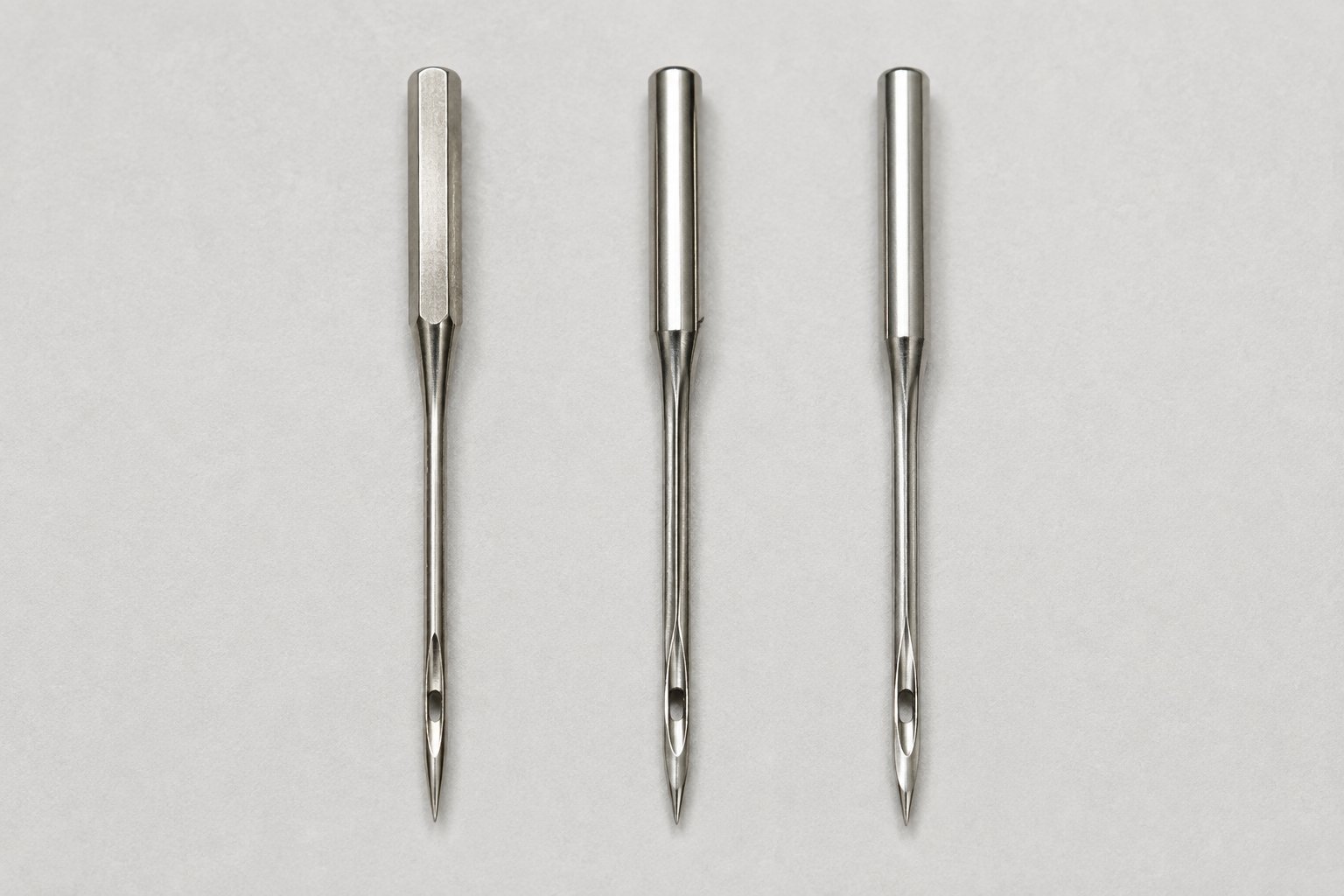
Household and industrial-style sewing machine needles arranged side by side.
The image is an editorial illustration of different needle forms, not evidence of a particular system or compatibility relationship.

System, size and needle type are three different questions

What you're choosingExampleWhat it tells you
Needle system130/705 H, 135x17, 134Basic needle geometry and machine fit
Needle sizeNM 80 / 12Thickness of the needle blade
Needle type or pointUniversal, Jersey, Leather, StretchHow the needle is designed to handle a material or application

Needle packaging contains several pieces of information that are easy to read as one long mysterious code.

They aren't all doing the same job.

A machine can require one needle system while allowing several sizes and point types within that system.

Groz-Beckert describes the system as the first selection step. Once the correct system is established, size, point style and any special application design can be chosen for the material and sewing operation.

This is a much cleaner way to think about needles than treating every number on the packet as a different size.

What the needle system actually controls

A sewing machine needle looks simple until two incompatible ones are placed next to each other.

The important geometry can include the shank diameter and shape, overall length, position of the eye, scarf and other construction details.

Those dimensions matter because the needle has to work with parts of the machine that are moving very close to it.

The shank sits in the needle bar or clamp. The eye has to reach the correct position. The scarf creates clearance for the hook or looper to catch the thread loop as the stitch is formed.

A needle that is nearly right is therefore not necessarily right enough.

This is why a needle system is a compatibility specification rather than a description of how thick the fabric is.

80/12 is a size, not a system

The pair of numbers printed prominently on household needle packets causes a lot of unnecessary confusion.

Take 80/12.

SCHMETZ defines the NM number from the diameter of the needle blade. NM 80 means a blade diameter of about 0.80 mm. The second number, 12, is the corresponding size on the alternative sizing scale still commonly shown alongside it.

So:

80/12 tells you how thick the needle is.

It does not tell you whether the machine needs 130/705 H, 134 or another system.

That is why finding an industrial needle in size 90/14 does not make it a substitute for a household 90/14 needle.

Same size. Potentially very different needle.

130/705 H is the common household system

For a normal modern household sewing machine, 130/705 H is usually the first system you'll encounter.

SCHMETZ describes 130/705 H as the needle system used by nearly all home sewing machines. Its household needles use a flat shank, which helps position the needle correctly in the needle bar.

You may also encounter other names around this system.

SCHMETZ identifies 15x1 H as a cross-reference to 130/705 H, and also uses HAx1 as another name in its household Universal Needle documentation.

This is the first mildly irritating feature of needle systems.

One physical compatibility standard can turn up under more than one name.

If a machine manual specifies 130/705 H, the system is more important than whether the packet happens to lead with one of its recognised cross-reference names.

There are exceptions, especially among older machines, specialist high-speed models and overlock equipment. The manual still wins.

A household system can contain many different needles

Using 130/705 H does not mean every needle in the system is identical.

A conventional household machine may use different needles for woven fabric, stretch fabric, denim, embroidery, quilting or leather while remaining within the same broad machine-compatible system.

Those variants can differ in point shape, scarf, eye, coating and other details.

For example, SCHMETZ lists its Universal Needle as 130/705 H, while Stretch, Jersey and other needles add suffixes or modifications to the basic designation.

The useful distinction is this:

The system gets the needle into the correct machine family. The needle type and size adapt it to the sewing job.

Buying the correct system is therefore necessary, but it is not the end of needle selection.

Industrial machines don't use one universal needle system

This is where the subject becomes less tidy.

Industrial sewing machines use many needle systems because the machines themselves are built for different stitch types, feeds, speeds, materials and mechanical arrangements.

A heavy walking-foot machine does not automatically use the same needle as another industrial machine simply because both sew upholstery.

The JUKI DNU-1541 is a useful real example. JUKI specifies 135x17 for that machine series.

SewFitGuide therefore treats Needle System 135x17 as its own compatibility entity rather than filing it under a vague category called industrial needles.

The same applies to Needle System 135x16, which appears in other documented machine relationships in the SewFitGuide catalogue. Those two numbers look suspiciously similar. They still aren't a reason to substitute one for the other without checking the machine and the required needle variant.

For the narrower household-versus-industrial question, see 130/705 H vs industrial needle systems.

Industrial needle names reward attention to detail.

One system can have several names

Cross-reference names make industrial needles look more complicated than they sometimes are.

SCHMETZ, for example, groups the 134 (R) industrial system with designations including DPx5, 135x5 and SY 1955 in its current documentation.

That means two manuals or packages can use different codes while referring to the same underlying compatibility family.

This is useful once the equivalence has been verified.

It is dangerous when guessed.

Two codes that look related are not automatically equivalents. Likewise, a seller combining several numbers in one product title is not enough evidence by itself.

Use a manufacturer cross-reference, machine manual or strong technical needle catalogue to establish the relationship.

Apparently the needle industry had access to an unlimited supply of numbering systems.

Round shank and flat shank are an obvious clue

One physical difference is particularly easy to see.

Standard SCHMETZ household needles in the 130/705 H family have a flat shank. Many industrial systems use a round shank.

SCHMETZ's comparison of its 134 industrial family and household Universal Needle shows exactly this distinction. The standard household needle has a 2.04 mm flat shank, while the compared 134 industrial needle uses a 2 mm round shank.

That does not mean every flat-shank needle fits every household machine or every round-shank needle fits every industrial machine.

It is simply one visible part of the geometry.

Shank shape alone is an identification clue, not a compatibility lookup.

Overlockers are a good reason to check the manual

Household overlock machines sit awkwardly between simple rules.

SCHMETZ says many modern household overlockers can use normal Universal needles, but other models require dedicated systems. Its current list includes systems such as ELx705 CF, HAx1 SP and 130/705 H.

Those needles can differ in features such as thread grooves, shank geometry and point design.

For example, SCHMETZ describes ELx705 as having an additional thread groove above the scarf to support chain-stitch formation.

So “it's a home machine” does not settle the question.

Neither does “it's an overlocker”.

The exact model does.

What happens with the wrong system?

Sometimes the answer is obvious. The needle will not fit properly into the clamp.

Sometimes it is more annoying than that.

A needle can appear to install while placing the eye, scarf or other geometry in the wrong relationship to the hook or looper.

SCHMETZ warns that unsuitable needles in overlock machines can result in poor seams, skipped stitches and broken needles, with machine damage possible in the worst case.

So if a machine starts skipping stitches immediately after a needle change, checking the system belongs near the top of the list.

Do not solve a system mismatch by experimenting with tension until the machine surrenders.

How to find the needle system for your machine

Start with the exact machine model.

If that sounds familiar, it should. Sewing-machine compatibility keeps returning to the same boringly effective habit.

Use the guide to finding your sewing machine model number if the machine identity is unclear.

Then check the manufacturer manual or specification for terms such as:

For industrial machines, the system is often listed directly in the technical specifications.

If several system names appear, establish whether the manufacturer or needle maker treats them as genuine cross-references before buying.

Once the system is known, choose the correct size and point for the material and thread.

That order saves a remarkable amount of pointless troubleshooting.

Don't identify the system from the old needle alone

An old needle is useful evidence, but only if there is reason to believe it belonged in the machine.

Used sewing machines often arrive with somebody else's collection of needles in the accessory drawer. A needle already installed in the machine may also have been the last owner's failed attempt to fix a stitching problem.

Read any markings that remain and compare the needle geometry, but verify the result against machine documentation.

The same principle applies to online listings.

“Fits industrial sewing machines” is not a needle system.

Neither is “universal industrial needle”.

Get the code.

How SewFitGuide handles needle systems

SewFitGuide stores the needle system as a relationship to the exact machine model when there is enough evidence to publish it.

That lets the catalogue work in both directions.

Search the machine and part database when the machine model is known.

Or browse Parts & Systems when a needle-system code is already known and you want to see which published machines are linked to it.

For example, the 135x17 system page currently connects the system to machines for which that relationship has been verified.

The 135x16 system page does the same for its documented relationships.

A machine missing from one of those pages has not automatically been ruled incompatible.

It means SewFitGuide does not currently publish that relationship as verified.

That distinction is important with needle systems, because a plausible-looking cross-reference is very easy to turn into a confident mistake.

Official references used for this guide

  1. SCHMETZ Needles, “How To Read the Needle Package”
  2. SCHMETZ Needles, “Needle Guide”
  3. SCHMETZ Needles, “Needle Basics Q & A”
  4. Groz-Beckert, “Selecting the right needle”
  5. JUKI, “DNU-1541”