
Low Shank vs High Shank vs Slant Shank
Low shank, high shank and slant shank describe how certain presser feet and foot holders connect to the sewing machine.
They do not describe the job the foot performs.
A zipper foot can exist for more than one shank system. So can a walking foot, darning foot or quilting foot. Finding the right kind of presser foot is only half the problem. It still has to attach correctly to the machine.
For most people, the safest route is to identify the exact machine model first and use its manufacturer compatibility information. Shank type is useful for understanding the fit, but it shouldn't replace a model check.
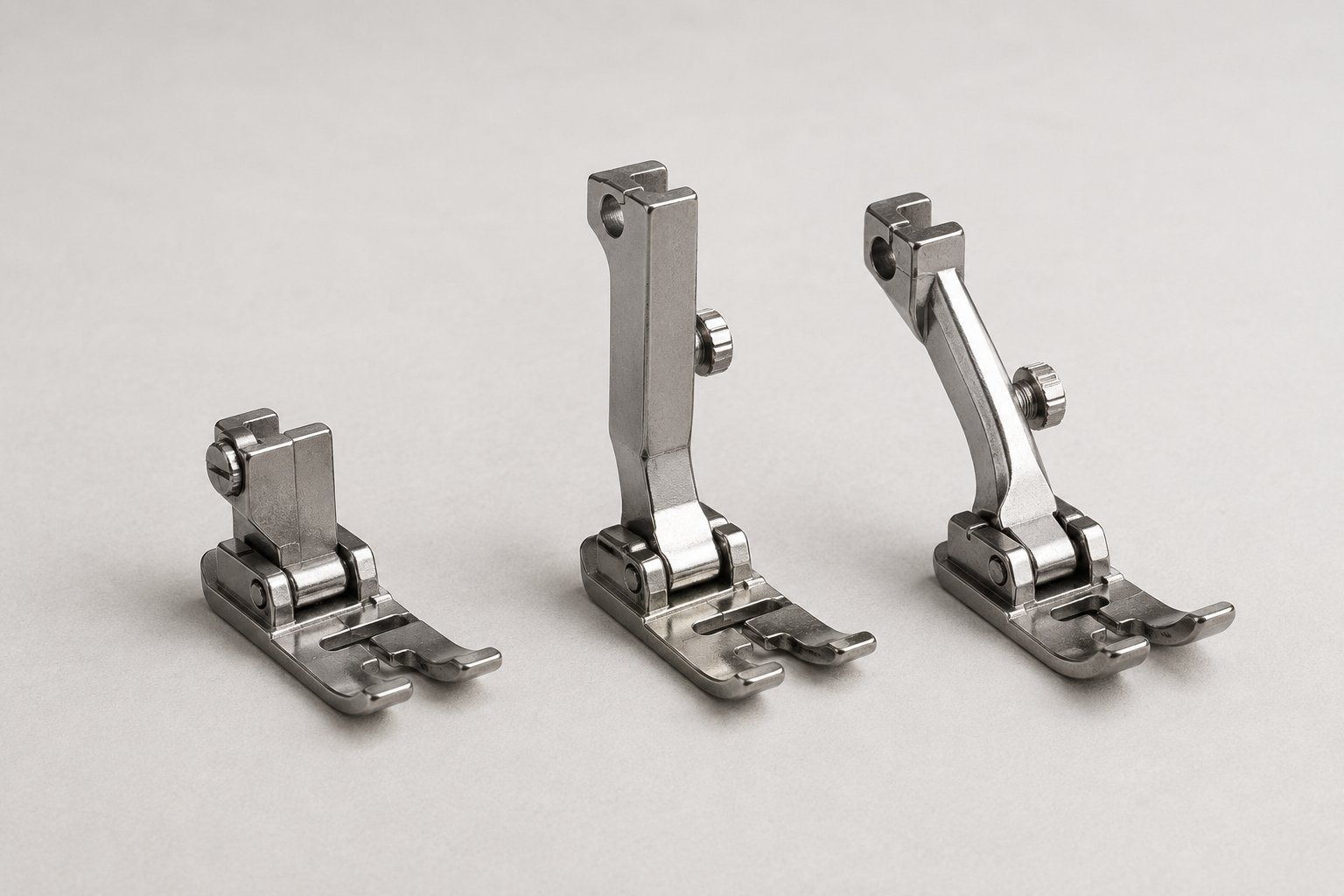
The three systems at a glance
| Feature | Low shank | High shank | Slant shank |
|---|---|---|---|
| Basic geometry | Lower attachment position | Higher attachment position | Attachment sits at an angle |
| Common context | Many household machines | Selected household, specialist and other machines | Mainly associated with certain older SINGER machines |
| Snap-on feet possible? | Often, with the correct holder | Depends on the machine and holder | Requires the appropriate slant system or adapter |
| Direct screw-on feet interchangeable with other columns? | No | No | No |
| Best compatibility check | Exact machine model | Exact machine model | Exact machine model |
That last row is deliberately repetitive.
Shank labels are helpful. The machine model is better.
What does “shank” mean on a sewing machine?
The terminology gets confusing because people often call several related pieces the presser foot.
On many modern machines, the small metal or plastic sole snaps onto a presser-foot holder, sometimes called an ankle.
The holder then attaches to the machine's presser bar.
Other accessories skip the snap-on holder completely. A walking foot, ruler foot or specialist screw-on foot may attach directly to the presser bar instead.
This distinction matters because shank height is especially important for accessories that attach directly to the bar. Janome makes that point explicitly in its current accessory compatibility guide.
So before deciding that a foot is “low shank” or “high shank”, check what part you're actually holding.
A loose snap-on sole is not the whole mounting system.
Low shank
Low shank is common on household sewing machines.
SINGER currently sells several accessories specifically for low-shank machines, including presser-foot kits and its even-feed walking foot. Brother's SA101 walking foot is likewise specified for low-shank machines.
That does not mean any foot described as low shank will fit every low-shank machine.
There can still be differences in the foot holder, stitch width, needle opening, attachment geometry and model-specific requirements.
SINGER itself has accessories where particular machines require an additional shank or adapter even though the accessory belongs broadly in its low-shank ecosystem.
“Low shank” narrows the field.
It doesn't finish the compatibility check.
High shank
High shank uses a taller mounting arrangement between the machine bed and the attachment point.
Janome still distinguishes explicitly between low-shank and high-shank machines in its accessory system. Its compatibility guide notes, for example, that machines equipped with AcuFeed are high shank, while several named models are high shank even without AcuFeed.
That tells us something useful.
High shank isn't just an old-machine category, and it isn't a synonym for industrial.
Modern specialist household machines can use high-shank arrangements too.
The accessory still has to match the specific machine.
Slant shank is different again
A slant-shank foot doesn't simply sit higher or lower.
The attachment geometry is angled.
The system is most strongly associated with a range of older SINGER slant-needle machines. Specialist vintage SINGER parts references still separate slant-shank feet from ordinary low and high shank feet, including feet for models in families such as the 301, 401 and 500 series.
Historical specialist documentation can help identify older slant-shank machines. It is secondary evidence, and the exact model still matters.
The practical point is simpler.
A slant-shank machine should not be treated as an ordinary low-shank machine because both happen to use screw-on feet.
The angle matters.
Snap-on does not mean universal
This causes almost as much confusion as the shank names.
A snap-on presser foot doesn't attach directly to the machine's presser bar. It clips onto a holder.
That can make accessories easier to share across compatible machines, but the holder is still part of the system.
Brother even sells adapters for particular machines where a low-shank screw-on foot would otherwise sit at the wrong height. Its SA131 adapter exists specifically because some screw-on feet do not have adequate height on the listed machines.
So:
Snap-on is an attachment method.
Low or high shank describes another part of the mounting geometry.
They are related, but they aren't synonyms.
A listing saying “universal snap-on foot” deserves the same treatment as most things described as universal in sewing-machine parts.
Check the machine.
Don't identify the system from the foot alone
A loose foot from a sewing drawer can be surprisingly unhelpful.
It may have been used with an adapter. It may be only the snap-on sole. It may not belong to the machine at all.
Used machines are especially good at accumulating mysterious accessories.
Start by identifying the machine itself.
If necessary, use the guide to finding your sewing machine model number.
Then check the manual or manufacturer accessory guide for the model.
Once the documented system is known, the loose feet become much easier to sort.
Can you measure shank height?
Yes, but measurements are better used as a cross-check than as the primary identification method.
One reason online advice becomes messy here is that measurement instructions aren't always consistent. Some charts measure relative to the needle plate. Others describe the distance to the attachment screw or use the bottom of an installed foot as a reference.
A few millimetres become surprisingly important once everyone is measuring from a different place.
Manufacturer documentation avoids much of that problem by telling you which accessory group the machine belongs to.
If measurement is necessary, remove the foot or holder as instructed for that machine, lower the presser bar and compare the attachment geometry with a reliable shank reference.
Do not alter the presser-bar height just to make an incompatible foot fit.
Low shank and high shank aren't quality levels
A high-shank machine is not automatically better than a low-shank machine.
The terms describe attachment geometry.
They don't tell you stitch quality, motor power, sewing speed or whether the machine can handle heavy materials.
Likewise, a low-shank machine isn't inherently a lightweight beginner machine. Plenty of capable household machines use low-shank accessories.
Choosing between the two is usually not a shopping decision at all.
The machine has already made the decision for you.
Walking feet are where this becomes obvious
Walking feet often attach directly to the machine rather than simply snapping onto the ordinary holder.
That means the correct attachment geometry matters.
SINGER's current Even Feed / Walking Presser Foot is explicitly designed for low-shank SINGER machines. Brother's SA101 is also explicitly labelled for low-shank machines.
Buying a walking foot because the fork appears to reach the needle-clamp screw isn't enough.
The mounting position, operating lever and needle clearance all need to work together.
This is why walking feet deserve their own compatibility check rather than being treated as one universal accessory. See walking foot attachment vs walking foot machine for the difference between the removable accessory and an integrated feed system.
There are systems outside these three
Low, high and slant shank are useful categories.
They are not a complete map of every sewing-machine presser-foot system ever made.
BERNINA, for example, uses its own attachment arrangements and sells adapter shanks that allow certain third-party short-shank accessories to be used on compatible BERNINA machines.
There are other proprietary and specialist systems too.
So if a machine doesn't look convincingly low, high or slant shank, don't force it into the nearest category because a compatibility chart only has three columns.
Find the actual system.
How to check before buying a presser foot
For an unfamiliar machine, use this order:
- Find the exact manufacturer and model number.
- Check the manual or official accessory compatibility information.
- Determine whether the accessory is a snap-on sole, a holder or a complete screw-on attachment.
- Confirm the required shank or attachment system.
- Check model-specific requirements such as stitch width and needle clearance.
- Match an OEM part number or explicit compatibility list where available.
- After installation, turn the handwheel manually before sewing to make sure the needle clears the foot.
That process is less exciting than buying a 42-piece “universal” presser-foot set.
It also has a better chance of ending with 42 pieces that aren't sitting unused in a drawer.
Find compatible feet from the machine
SewFitGuide works from the machine outward.
Search the exact model in the machine and part search and use any published compatibility relationships attached to that machine.
The Parts & Systems directory can be used in the other direction when an exact accessory or part number is already known.
A missing presser-foot relationship does not mean every other foot has been tested and rejected.
It means SewFitGuide has not published that specific compatibility relationship as verified.
With presser feet, that is considerably safer than assuming the word “low shank” settles everything.
Official references used for this guide
- Janome, “Presser Foot Attachment Quick Reference Guide”
- Brother, “SA101 Compact Walking Foot”
- Brother, “SA131 Adapter for screw-on feet”
- SINGER, “Even Feed / Walking Presser Foot”
- SINGER, “Presser Feet”
- BERNINA, “Short Adapter Shank #77”
- Specialist secondary evidence: The Singer Featherweight Shop, “Presser Foot Attachment, SLANT SHANK”