
How OEM Sewing Machine Part Numbers and Superseded Numbers Work
A sewing machine part number is an identifier. It is not, by itself, a complete compatibility statement.
The same physical part can appear under more than one manufacturer code, while two parts with nearly identical names can have different numbers and fit different machines. Older numbers may also be replaced or superseded as manufacturers revise parts and assemblies.
The useful job is not simply finding a number. It is working out what relationship that number has to the machine and to any newer number.
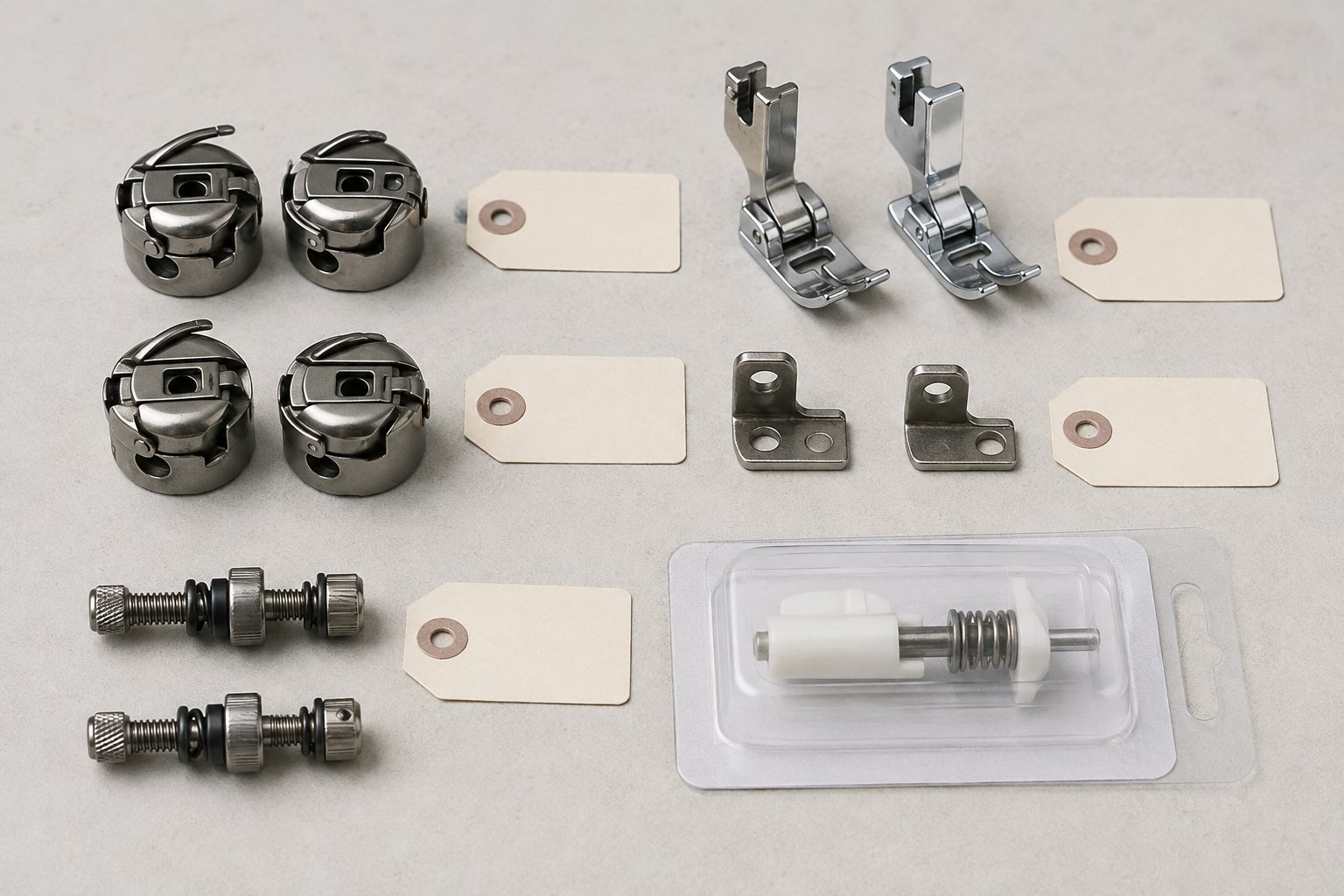
The common number relationships
| Relationship | What it means |
|---|---|
| OEM part number | Manufacturer identifier for a specific part or accessory |
| Alternate OEM code | Another manufacturer code used for the same documented item or market |
| Accessory model code | A retail-facing manufacturer code such as SA156 or EF74 |
| Superseded number | An older number the documentation says has been replaced by another number or part |
| Replacement assembly | A newer complete assembly that may replace several older components |
| Aftermarket SKU | A seller or third-party identifier, not automatically an OEM cross-reference |
Those relationships should not be flattened into one column called "other numbers".
Several OEM codes can identify the same documented item
Brother's SA156 bobbin is a useful modern example.
Brother manuals identify the compatible bobbin as "SA156, SFB: XA5539-151". The current Brother SA156 product page uses SA156 as the accessory code, while the manuals preserve the SFB and XA5539-151 identifiers.
That does not mean one of those codes superseded the others.
They are documented alternate Brother identifiers for the same bobbin type in that context.
SewFitGuide therefore stores SA156, SFB and XA5539-151 as separate part-number records attached to the same Brother SA156 bobbin entity, without inventing a supersession relationship.
The same accessory name can hide different parts
Names are often weaker than numbers.
Janome's current Zipper Foot page lists several different zipper-foot part numbers for different machine groups. The 7 mm "New Shape" Zipper Foot E is part 808852003, while a front-load version is part 940290000, and other zipper-foot variants have their own numbers.
Searching only for "Janome zipper foot" loses the distinction the catalogue is trying to preserve.
What does superseded mean?
In parts documentation, "superseded" generally means an older part or identifier has been replaced in the manufacturer's later parts chain.
Historical SINGER parts lists show why the exact wording matters. In the parts list for Machine 19-18, obsolete Presser Bar Lifter 2062 is listed as superseded by 52016. The same list also shows older shuttle-race components superseded by newer numbers while explicitly marking some of those individual components as "not interchangeable".
The complete old shuttle-race assembly 17444 is separately shown as superseded by assembly 22705.
So a supersession can describe a later service path without promising that every old subcomponent swaps directly with its newer counterpart.
That is exactly the sort of detail that disappears when a retailer turns a parts chain into "replaces 17442".
“Use” and “superseded by” are not always the same relation
Older parts books can use several instructions.
A listing might say "use" another number, "superseded by" another number, or mark a part obsolete. Those phrases should be preserved rather than silently translated into a universal equivalence.
If the source says a newer complete assembly replaces an older assembly, store that relationship at the assembly level. Do not automatically infer that every screw, plate and spring inside the two assemblies is interchangeable.
Regional codes can make one part look like several parts
Brother quick-reference guides sometimes show one accessory code for the Americas and another code for other markets. A Brother embroidery frame may appear as an SA-series accessory in one column and an EF-series code plus an XC service code in another.
That is not evidence of a global supersession sequence. It is evidence that region and code type matter.
A retailer number is not automatically an OEM number
Specialist sellers often add their own SKU, bundle code or cross-reference. That can be useful for finding stock, especially when the original part is obsolete. It should still be kept separate from the manufacturer's own identifier.
The same applies to aftermarket parts advertised as replacing an OEM number. The claim may be correct, but it is an aftermarket compatibility claim until it is corroborated appropriately.
A seller title is not a manufacturer parts bulletin wearing a cheaper font.
Why old numbers are still worth keeping
An obsolete number can be the best search key available. It may be printed in the original manual, stamped on the old part, listed in a vintage service book or repeated in years of repair documentation.
Deleting the old number when a new one appears makes the replacement harder to discover.
A useful cross-reference keeps the history: old number -> documented replacement or superseding number -> current part or assembly -> compatible machine models.
If a second supersession happens later, keep the chain rather than overwriting the first link.
How to research a mystery number
- Copy the complete number exactly, including letters, hyphens and suffixes.
- Identify where the number came from: machine manual, parts book, old component, package, dealer label or aftermarket listing.
- Search the exact number in manufacturer manuals and official accessory or parts information.
- Check the exact machine model and revision before assuming the number belongs to it.
- If another number is listed, record the wording used by the source: alternate code, use, replacement, superseded by or another explicit relation.
- Check whether the replacement refers to the same individual component or to a larger assembly.
- Use specialist secondary sources only where manufacturer documentation is unavailable or needs historical interpretation.
How SewFitGuide stores part numbers
SewFitGuide separates the part entity from its identifiers. A single verified part can therefore carry several documented OEM codes without creating duplicate part pages.
The current data model also has a dedicated supersedes-part-number relationship. That field should only be populated when evidence actually establishes the direction of the replacement chain.
For example, the Brother SA156 record currently links SA156, SFB and XA5539-151 to one part entity, but none of those codes is marked as superseding another. That matches the Brother documentation rather than inventing a tidy chronology that the source never gave us.
Use the Parts & Systems directory when an exact part number is known, or search by machine model when the number is still missing. Use the guide to finding your sewing machine model number before applying a part-number cross-reference.
The goal is not to collect the largest possible pile of numbers. It is to know what each number actually means.