
Class 15 vs Class 15J Bobbins: What’s the Difference?
Class 15 and Class 15J bobbins are close enough in name and appearance to end up mixed together in the same sewing box. For SINGER machines, though, they are not the same bobbin. SINGER lists different dimensions and profiles for the two and specifically says not to substitute one for the other.
The easiest visual clue is the edge profile. A SINGER Class 15 transparent bobbin has flat top and bottom surfaces. A Class 15J has a very slight curve. The 15J is also a little smaller.
That difference is easy to miss when the bobbins are sitting loose on a table. Apparently adding one letter to the name was considered sufficient warning.
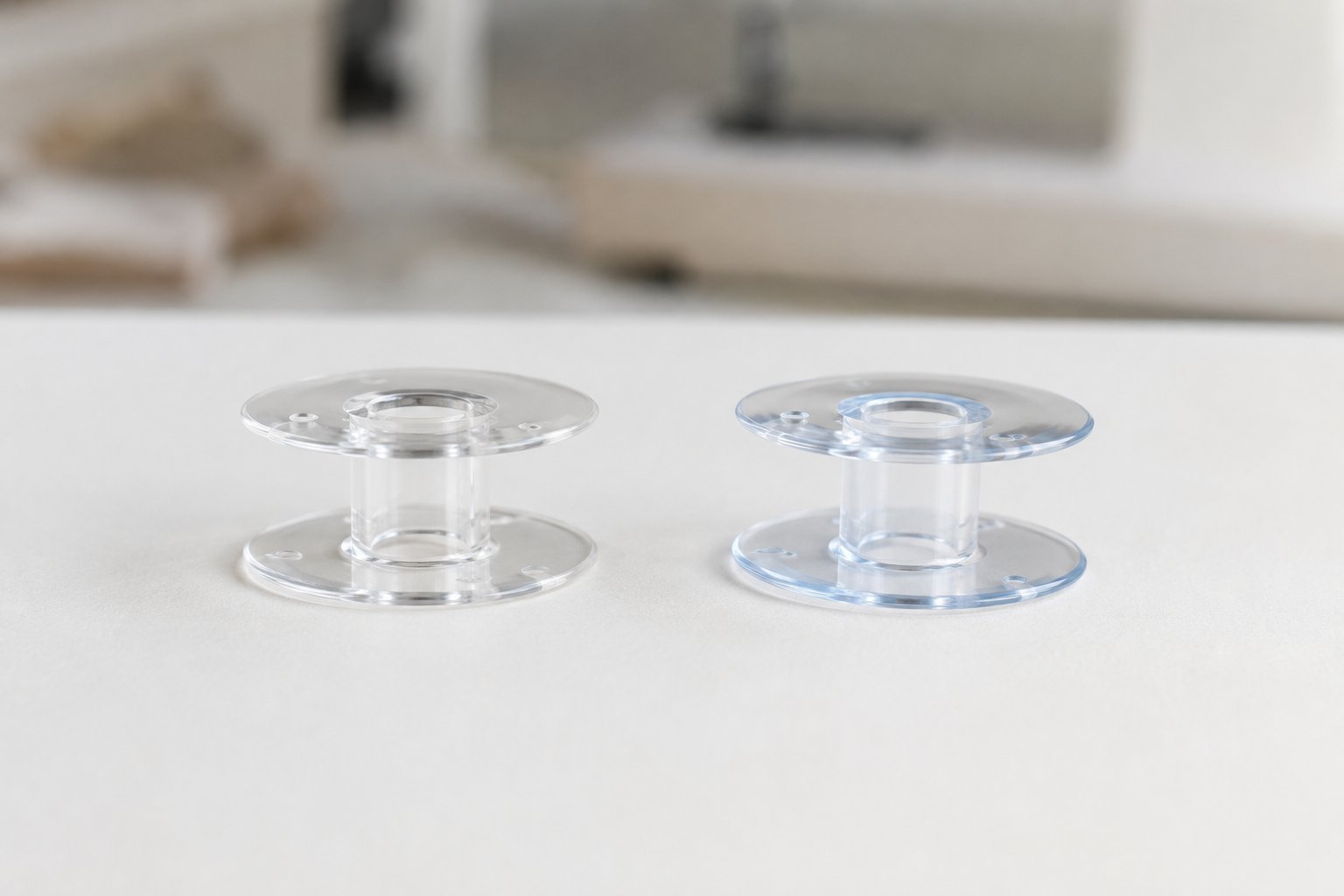
Class 15 vs Class 15J at a glance
| Feature | Class 15 transparent | Class 15J |
|---|---|---|
| Approximate height | 12 mm | 11 mm |
| Approximate diameter | 21 mm | 20 mm |
| Top and bottom | Flat | Very slightly curved |
| Appearance | Clear plastic | Clear plastic, often with a slight blue tint |
| Interchangeable according to SINGER | No | No |
These are the approximate metric dimensions currently given by SINGER. The important point is not whether a home measurement lands exactly on the same millimetre. It is that SINGER treats the two as separate bobbin types and tells owners to use the class specified for the machine.
SewFitGuide keeps separate compatibility records for the SINGER Class 15 Transparent Bobbin and the SINGER Class 15J Bobbin.
Why they are so easy to confuse
Put a Class 15 and a 15J next to each other and the difference is not dramatic.
Both are transparent plastic bobbins. Both belong to SINGER's domestic sewing-machine ecosystem. Their names are almost identical, and the difference in overall size is small enough that judging from memory is unreliable.
The profile is more useful than the name printed on a random retail listing. SINGER describes the Class 15 transparent bobbin as flat across the top and bottom. The 15J has a slight curve on those surfaces and may have a faint blue tint.
Even that should be treated as an identification clue, not as the final compatibility test. The exact machine model is stronger evidence.
Are Class 15 and Class 15J bobbins interchangeable?
For SINGER machines, no.
SINGER explicitly tells owners not to replace a Class 15 transparent bobbin with a Class 15J, and gives the same warning in the opposite direction.
That matters because the machine is designed around a particular bobbin system. SINGER warns that using the wrong bobbin class can cause tension problems, skipped stitches and thread jams, and may damage the bobbin case.
A bobbin dropping into the opening is therefore not a compatibility test.
Nor is the fact that a machine manages to form a few stitches with it.
If the manual specifies Class 15J, use Class 15J. If it specifies Class 15 transparent, use that instead.
How Class 15 is different
The transparent SINGER Class 15 is the larger of the two in SINGER's current comparison.
SINGER gives it an approximate height of 12 mm and diameter of 21 mm. Its top and bottom surfaces are flat, and the transparent version has no colour tint.
That flat profile is one of the quickest ways to distinguish it from a 15J when both are available for comparison.
There is another complication. SINGER also has metal Class 15 bobbins for machines that specify them. A shared class number does not mean that plastic and metal versions should automatically be swapped.
Material is part of the machine-specific requirement too.
The practical rule is simple. Read the complete bobbin specification, not only the number 15.
How Class 15J is different
SINGER lists the Class 15J at approximately 11 mm high and 20 mm in diameter.
The top and bottom surfaces have a very slight curve rather than being completely flat. SINGER also describes the transparent plastic as having a slight blue tint.
The difference is subtle. That is why identifying a loose bobbin purely by looking at it can become surprisingly annoying.
SINGER currently lists Class 15J bobbins for selected machine groups rather than treating 15J as a replacement for every machine that uses something called Class 15. The SINGER Class 15J compatibility page on SewFitGuide shows the model relationships currently supported by the site's verified data.
What if the wrong bobbin seems to work?
This is where sewing-machine compatibility can be deceptive.
The wrong part does not always announce itself by refusing to fit. Two bobbins can be close enough physically that one sits in the machine and appears normal.
SINGER's own guidance is stricter than that. It tells owners to use bobbins of the same class or style supplied for the machine and not to substitute between the Class 15, Class 15J and other bobbin systems.
So a successful test seam does not turn an undocumented substitution into a confirmed one.
If a machine has been bought second-hand and came with a box of mixed bobbins, assume the accessory box may be wrong until the machine model says otherwise.
How to find which bobbin your machine actually needs
Start with the machine, not the loose bobbin.
Find the exact model number and check its instruction manual, manufacturer support information or an explicit compatibility listing. SINGER recommends checking the manual or the product information for the machine to establish the required class.
If the original bobbin is still available, compare it afterwards. Shape, material and dimensions can help confirm that the replacement looks sensible.
The order matters.
Model first. Bobbin second.
If the model number is unclear, use the SewFitGuide machine and part search or browse the SINGER machine directory. The Parts & Systems directory can also be used in the opposite direction to see which published machines are linked to a particular bobbin.
Do not rely on “Class 15” as a universal shopping label
Bobbin terminology becomes less tidy once different manufacturers and aftermarket suppliers are involved.
A class name is useful, but it should not override a machine-specific part number or an explicit manufacturer compatibility list. Similar dimensions do not prove that two parts behave identically in the hook and bobbin system.
This is why SewFitGuide stores compatibility as a relationship between an exact machine and an exact part or system rather than assuming that anything carrying a similar retail label fits.
The same principle applies beyond these two bobbins. The Brother SA156 Bobbin, for example, has its own manufacturer-backed compatibility relationships even though Class 15 terminology also appears in Brother documentation.
If you have both types in the same box
Do not guess which one belongs in the machine.
Separate them, identify the machine model and keep only the specified class with that machine. A slight curve or tint may help distinguish a 15J from a transparent Class 15, but use those clues to confirm documentation rather than replace it.
If the model record on SewFitGuide currently covers only one or two parts, that does not mean every other bobbin has been tested and rejected. It means the site only publishes compatibility relationships for which it has sufficient evidence.
That distinction is less exciting than a universal bobbin chart, but considerably more useful when the wrong piece of plastic is only a millimetre away from the right one.
Sources
- SINGER UK, “SINGER 15 Class Plastic Bobbins 10-Pack”Official accessory compatibility page
- SINGER Support, “How do I choose the right Singer bobbin?”Official support guide
- SINGER, “SINGER Class 15J Transparent Bobbins 3-Pack”Official accessory product page