
Sewing Machines for Boat Covers, Canvas, Awnings and Camper Projects
For boat covers, biminis, awnings, camper canvas and similar outdoor work, the useful question is not simply whether a sewing machine can punch through canvas.
The finished seams can include folded hems, binding, webbing, zippers and several layers meeting at once. Feeding those assemblies consistently is usually the harder test.
For regular marine or heavy canvas work, a machine with a built-in walking-foot or compound-feed system is the safer starting point. A portable walking-foot machine makes sense when portability or zigzag capability matters. A full-size compound-feed table machine makes more sense when the work is mainly large, heavy and repetitive.
There is no single "boat cover machine" that is best at every version of the job.
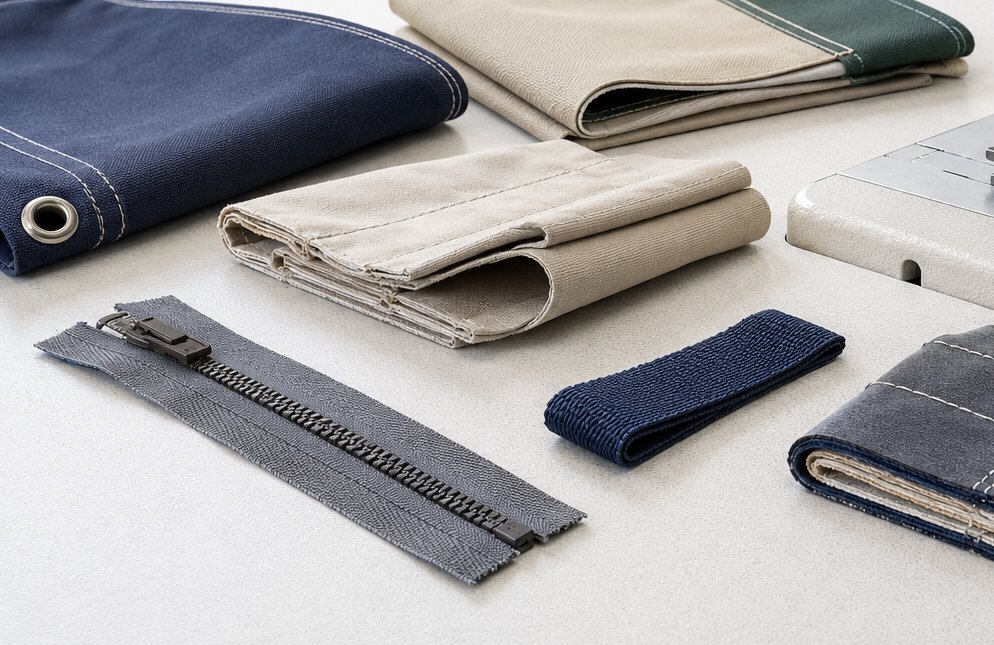
Match the machine to the finished seam
| Work pattern | Machine type that usually fits the job | Why |
|---|---|---|
| Portable repairs, boat canvas, occasional sail work | Portable walking-foot machine, straight or zigzag as needed | Moves to the project and controls layered fabric without a full industrial table |
| Frequent boat covers, awnings, upholstery, camper covers | Full-size compound-feed or unison-feed flat-bed machine | Strong layered feeding, large-bobbin options and better support for sustained heavy work |
| Sail repair or work that genuinely needs zigzag | Walking-foot machine with documented zigzag capability | Straight-stitch industrial machines cannot provide a zigzag simply because the material is heavy |
| Bags, tight curves, cylindrical or hard-to-reach assemblies | Cylinder-arm compound-feed machine | Open space around the arm improves access around shaped work |
That table is a decision aid, not a compatibility chart. The exact machine specification still decides what the machine can use and do.
A canvas swatch is not the same as a boat-cover seam
A machine may sew one or two layers of canvas perfectly and still struggle at the place that matters.
Boat covers and camper canvas accumulate thickness at hems, patches, zipper ends, binding and webbing reinforcement. Upholstery can add vinyl, foam-backed material and piping. Awnings add their own folded edges and reinforcement.
So do not judge a machine only by the thickest flat sample you can force under the foot.
Look at feed type, presser-foot clearance, stitch length, needle and thread range, bobbin capacity, bed shape and how controllable the machine is at low speed.
Walking foot matters because layers want to move
Bottom feed alone can let the lower layer advance differently from the upper layers. Built-in walking-foot, top-and-bottom or compound-feed systems add active feeding above the material.
Consew 206RB-5 is a compound-feed machine with alternating walking presser feet for materials including canvas, vinyl, upholstery, sails, tents, camping trailer covers and awnings. JUKI's DNU-1541 series uses unison feed and is positioned for heavy multilayer materials.
Those are machine-level feeding systems, not removable household walking-foot attachments. See Walking Foot Attachment vs Walking Foot Sewing Machine for that distinction.
Straight stitch is enough for a lot of canvas work
Do not buy zigzag merely because the project is marine.
Sailrite's own LS-versus-LSZ guidance recommends straight stitch for canvaswork, upholstery, awnings, boat covers, dodgers and biminis. It points to zigzag for sail repair and sailmaking, and for some operations such as binding scalloped awnings.
If the work is mainly boat covers, camper covers and upholstery, a good straight-stitch walking-foot machine can be entirely appropriate. If sail work or another genuine zigzag operation is part of the plan, the machine needs to provide that stitch mechanically.
Portable walking foot: useful when the machine has to travel
Sailrite's Ultrafeed LSZ is a useful example of the portable category.
Sailrite documents it for boat and canvaswork, biminis, dodgers, outdoor living projects, upholstery and custom sails. The current LSZ specification gives straight stitch up to 6 mm, zigzag up to 5 mm, a 3/8 inch (9.5 mm) presser-foot lift and 135x17 or 135x16 needle systems.
Its main advantage here is not that it beats every industrial machine on raw specification. It is that a walking-foot machine with straight and zigzag capability can be carried to a boat, workshop or camper rather than permanently living in an industrial table.
Full-size compound feed: better suited to sustained heavy straight stitching
For regular production or large projects, full-size table machines are a different proposition.
The Sailrite Fabricator is a straight-stitch compound walking-foot machine built for canvas, upholstery and awning shops. The Consew 206RB-5 gives a 10 mm maximum stitch length, 14 mm presser-foot clearance, 135x17 needle system and M bobbin. JUKI's DNU-1541 provides another unison-feed option with up to 9 mm stitch length, 135x17 needles and up to 16 mm presser-foot lift with the knee lifter.
Those numbers are useful when comparing a defined requirement. They are not an invitation to rank machines from one headline dimension.
Cylinder arm is useful for shaped work, not automatically better for giant flat covers
Cylinder-arm machines put less bed around the needle area, which makes it easier to turn bags, corners, gussets and other closed or three-dimensional work.
Techsew's 2750 PRO is a cylinder-arm compound walking-foot system for leather, nylon webbing, canvas, upholstery and other heavy fabrics. It uses 135x17 or 135x16 needles and includes a flatbed attachment in the current PRO package.
For cushions, bags and awkward shaped assemblies, that access can be extremely useful. For a very large flat boat-cover panel, a conventional flat-bed table may be simpler to support. Different geometry, different annoyance.
Presser-foot lift and sewing capacity are not the same number
Presser-foot lift describes the available clearance created by the lifting mechanism. A stated maximum sewing thickness is a separate claim. Neither number, on its own, describes how cleanly a machine will climb a hard seam transition or feed a slippery stack.
Compare like with like.
Needle and thread capacity belong in the decision too
The DNU-1541 and 206RB-5 both document 135x17 needle systems. Sailrite documents 135x17 and 135x16 for the Ultrafeed. Techsew documents both systems for the 2750 PRO and publishes a defined thread-size range.
Use the machine's actual needle and thread specification rather than choosing a thicker needle because the canvas looks intimidating. The sewing-machine needle-system guide explains why needle size and needle system are separate compatibility questions.
Large bobbins matter more on large projects than they do in a spec-sheet argument
A boat cover contains a lot of seam.
Large-capacity hooks and bobbins reduce how often the lower thread needs attention during long runs. Consew specifies an M bobbin for the 206RB-5, while JUKI describes the DNU-1541 as using a double-capacity hook.
That will not fix poor feeding or the wrong needle system. It is simply one of the practical differences that becomes more noticeable on large work.
Slow control is more useful than a heroic top speed
For DIY canvas and marine work, controllable low-speed torque and predictable feeding are generally more useful than maximum production speed. Servo-motor packages and speed-reduction systems are popular for exactly that reason.
When comparing complete packages, check the motor and control setup as well as the sewing head.
A practical shortlist by use case
| Example | Why it belongs on the shortlist | Main limitation to remember |
|---|---|---|
| Sailrite Ultrafeed LSZ | Portable walking foot plus straight and zigzag, documented for marine canvas and sails | Portable format and smaller work area than a full industrial table |
| Sailrite Fabricator | Full-size straight-stitch compound feed for canvas, upholstery and awning work | No zigzag |
| Consew 206RB-5 | Compound feed, long stitch, high foot clearance and explicit boat, camping and awning applications | Full industrial table machine |
| JUKI DNU-1541 | Industrial unison feed with strong heavy-material specification | Straight stitch and full-size installation |
| Techsew 2750 PRO | Cylinder-arm compound feed for shaped canvas, upholstery, bags and webbing | Cylinder geometry is not the default choice for every large flat panel |
These are documented examples of different machine categories, not a sponsored ranking.
What about a domestic heavy-duty sewing machine?
Some domestic heavy-duty machines are officially marketed for canvas and can be perfectly useful for lighter projects. That does not establish that they are suitable for every finished marine assembly, and adding a removable walking foot does not change the rest of the machine's mechanical capacity.
If the plan is full boat covers, repeated awning work, camper canvas or upholstery, choose from the finished seam backwards rather than from the word "heavy duty" forwards.
How to choose without buying twice
- List the actual projects: boat cover, bimini, camper cover, upholstery, awning, tent repair, sails or another mix.
- Decide whether zigzag is genuinely required.
- Look at the thickest finished seam stack, including hems, binding, webbing and zipper junctions.
- Choose the feed architecture: portable walking foot, full-size compound or unison feed, or cylinder arm for shaped work.
- Check presser-foot lift, stitch length, needle system, needle-size range, thread range and bobbin or hook capacity from the manufacturer.
- Consider the work area and whether the machine must travel.
- Compare complete motor and table packages, not just the bare machine head.
- Use exact machine documentation before buying needles, feet, bobbins or other compatible parts.
Use SewFitGuide to move from project type to exact machine data
SewFitGuide's role is not to declare one universal winner for canvas. The useful path is project -> machine type -> exact model -> verified systems and parts.
Use search and Parts & Systems to follow those relationships. A boat cover is large enough without also making the compatibility research larger than it needs to be.